
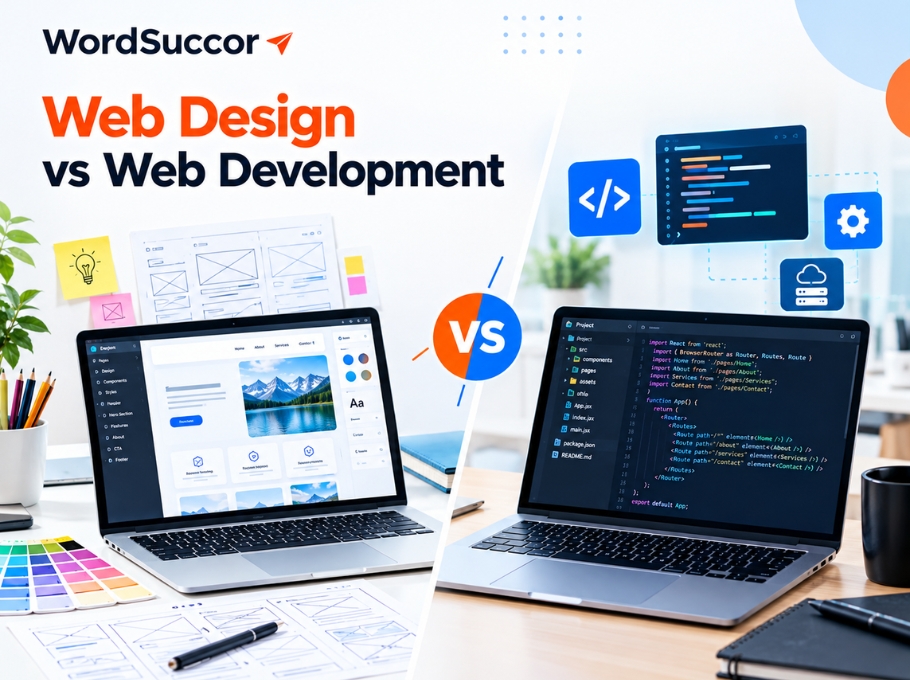
People often use “design” and “development” interchangeably when talking about a website. They’re actually two distinct disciplines. Confusing them tends to cause real problems once a project is underway.
Understanding the difference matters most when you’re hiring for a new site. Getting web design & development services confused often means budgeting for the wrong thing. It can also mean hiring a specialist who only covers half of what your project actually needs.
This guide breaks down what each discipline covers, and how they differ from one another. It also looks at how the two work together, and what this distinction means specifically for a WordPress website. The same principles apply whether you’re building a brand-new site or overhauling an existing one.
Key Takeaways
- Web design focuses on how a site looks and feels. Web development focuses on how it functions.
- Designers work with layout, color, typography, and user experience. Developers write the code that brings those decisions to life.
- Most professional websites need both disciplines, whether from one person, one team, or two separate specialists.
- On WordPress, design usually means theme and visual work. Development covers custom functionality and integrations.
- Knowing which skill set your project needs prevents budget mismatches and unmet expectations later on.
What Is Web Design?
Web design is the practice of planning how a website looks and how visitors experience it. This covers layout, color palette, typography, imagery, and the overall visual identity of the site.
Good design goes beyond appearance. It also covers user experience. That means how easily a visitor can move through the site, read the content, and complete an action. That action might be filling out a form or making a purchase.
Designers typically work with tools like Figma or Adobe XD to create mockups before any code gets written. These mockups map out every page and state a site will need, from the homepage to a form’s error message. WordPress web design specifically often means designing within the constraints of a WordPress theme. The final site needs to work within that platform, not just look good in a separate file.
Consistent branding across every page also falls under design. A visitor should recognize your site instantly, whether they land on the homepage or a blog post several clicks deep.
What Is Web Development?
Web development is the practice of building the actual, functioning website from a design. This means writing the code that turns a static mockup into a working, interactive site.
Development splits into two main areas. Front-end development handles what happens in the visitor’s browser: layout rendering, interactive elements, and responsive behavior across devices. Back-end development handles what happens behind the scenes. That includes databases, server logic, and how content gets stored and retrieved.
WordPress web development usually means working with themes, plugins, and the WordPress core itself. Developers build the functionality a design calls for. That might be a contact form, a product catalog, a booking system, or a custom dashboard. Some of this work is configuration. Some of it involves writing original code from scratch.
Development doesn’t end at launch either. Updates, security patches, and bug fixes all fall under this discipline long after the site first goes live.
Web Design vs Web Development: Key Differences
The two disciplines require different skills and produce different outputs, even when working on the exact same project. Some professionals build strength in both areas over time, though most tend to specialize in one.
| Aspect | Web Design | Web Development |
|---|---|---|
| Main focus | Appearance and user experience | Functionality and technical performance |
| Typical tools | Figma, Adobe XD, Photoshop | Code editors, WordPress, PHP, JavaScript |
| Core skills | Visual design, layout, UX principles | Programming, database management, debugging |
| Output | Mockups, wireframes, style guides | A working, functional website |
| Common questions | Does this look right? Is it easy to use? | Does this work? Does it load fast and stay secure? |
Neither role is more important than the other. A beautifully designed site that doesn’t function properly frustrates visitors quickly. A flawlessly coded site with a confusing layout drives them away just as fast, even if every button technically works.
How Web Design and Development Work Together
On a professional project, design typically comes first. The designer creates mockups and gets sign-off on the visual direction before development begins in earnest.
Development then takes those mockups and builds them into a working site. This isn’t a purely mechanical handoff, though. Good developers flag design choices that will be difficult or slow to implement. Good designers, in turn, stay open to adjustments once real content and real code enter the picture.
Consider a simple example. A designer might mock up a product page with a large image gallery. The developer then has to decide how to load those images without slowing the page down. That sometimes means going back to the designer with a suggested change.
The two roles overlap more than a clean division suggests. A developer often makes small design decisions during implementation, such as spacing or responsive behavior on smaller screens. A designer benefits from understanding basic development constraints too. That way, mockups don’t include features that are impractical to build within budget or timeline.
On smaller projects, one person sometimes handles both roles well. On larger projects, dedicated specialists usually produce a stronger result. Each person can focus fully on their own area of expertise. Attention isn’t split across two very different skill sets.
Website Design and Development: Common Misconceptions
A few misunderstandings come up often enough to be worth addressing directly.
- “A nice-looking site means good design.” Visual appeal is only part of it. A site can look polished and still confuse visitors with poor navigation or an unclear layout.
- “Development just means writing code.” Development also involves problem-solving. It means figuring out how a feature should behave, not just how to code it. Good developers make real judgment calls throughout a build.
- “Page builders remove the need for developers.” Page builders make basic layout changes easier for non-developers. They don’t replace custom functionality, performance optimization, or the technical judgment a developer brings to a complex project.
- “Design and development can happen in either order, it doesn’t matter.” Order usually does matter. Building before design is settled often means expensive rework once decisions change midway through.
- “A redesign always means starting from scratch.” Many redesigns keep the existing development foundation and only update the visual layer. The reverse is also common: new functionality built on top of an existing design.
Web Design and Development on a WordPress Website
WordPress makes the design-development split especially visible, since the platform itself separates these concerns to some extent.
Design work on WordPress usually centers on the theme. That includes layout, colors, typography, and how content appears across different page types. This can mean customizing an existing theme, or building one from scratch to match a specific brand. WordPress theme development covers exactly this part of the process.
Development work covers everything beyond the visual layer: custom functionality, plugin integrations, database structure, and performance. Projects with specific business requirements, such as a booking system or a member portal, usually need custom WordPress development. That kind of build handles features a standard theme and plugin setup simply can’t support.
A strong WordPress website services provider typically covers both sides of this work. At minimum, it coordinates closely between design and development specialists, so nothing falls through the gap between the two.
Which Do You Need First?
If you’re starting a new website project, design usually comes before development. Development needs a design to build from, in most standard cases. There are exceptions worth knowing about.
A few situations call for development-first thinking:
- Complex functionality drives the project. If the site is mainly a custom tool or application, technical requirements should come first. The design gets shaped around them, not the reverse.
- You’re working within an existing theme. Development constraints from the theme may limit what design changes are realistic to pursue.
- The budget is genuinely tight. Sometimes a simpler design, refined through development iteration, works better than a polished mockup the budget can’t fully build anyway.
- You’re redesigning an existing site. Current development limitations often shape what a new design can realistically include from the outset.
For most standard business websites, though, starting with design first produces the smoothest process. Development naturally follows from there.
Getting Both Right
Web design and web development solve different problems, and a strong website needs both done well. Design shapes how visitors feel about your site the moment they land on it. Development determines whether the site actually works the way it should, page after page.
At WordSuccor, our team handles both sides of web design and development services under one roof. Nothing gets lost between the two. Skipping either discipline tends to show up later, in higher bounce rates or a site that’s hard to maintain.
Ready to build a scalable, high-performing WordPress site?
Get in touch with our team to discuss custom WordPress development tailored to your exact business goals.
Get a Free Quote