
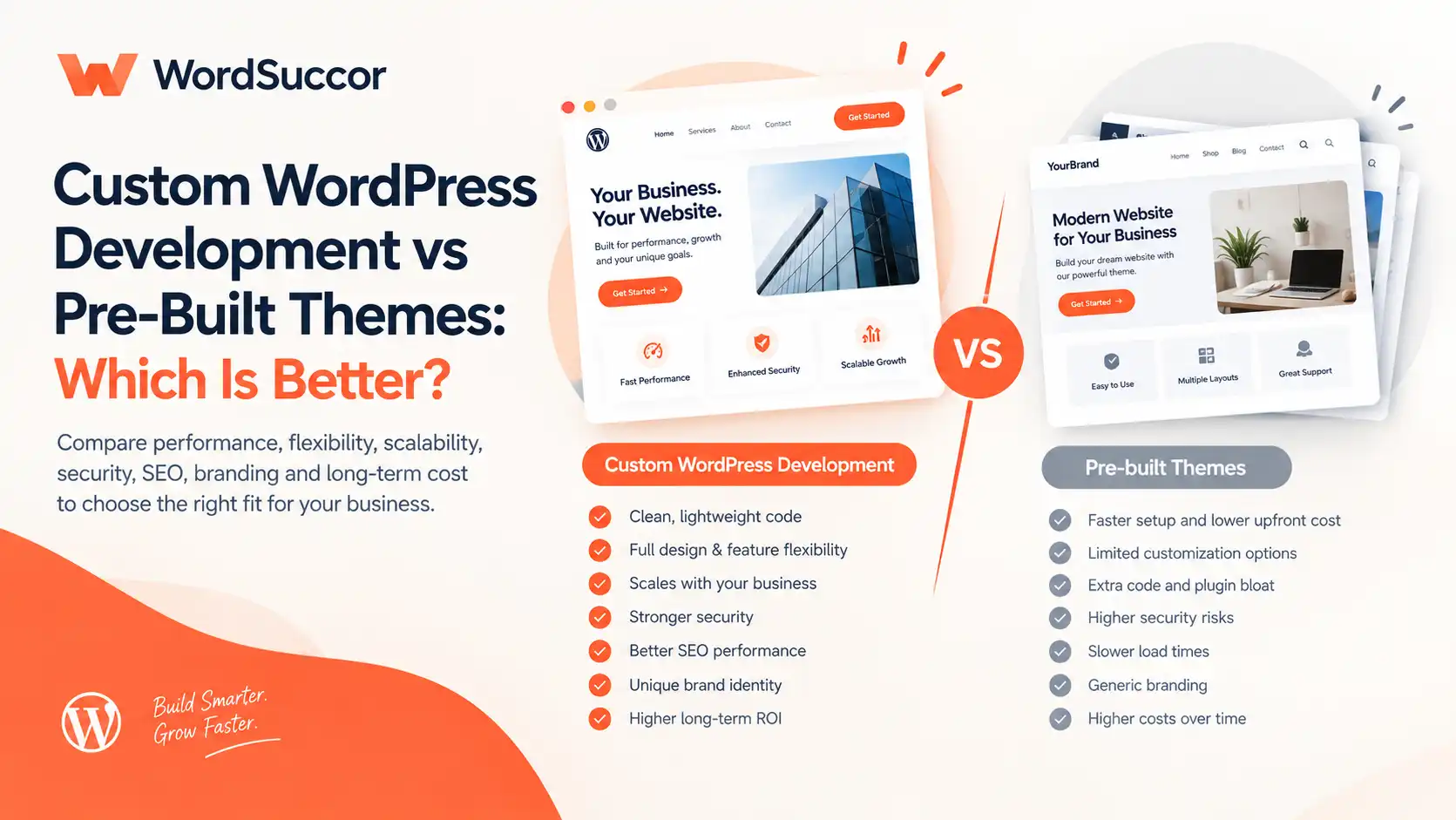
WordPress now powers close to 41-43% of all websites on the internet. Roughly six in ten sites that run on any content management system run on WordPress (HostingGuider, W3Techs data, 2026). That scale is exactly why the “theme or custom build” question matters more than it used to. Tens of thousands of pre-built themes are available, and more businesses are turning to custom WordPress solutions. That leaves businesses facing a real fork in the road early in any website project. The choice quietly shapes performance, security, and total cost of ownership for years afterward.
This guide compares custom WordPress development and pre-built themes across seven factors. These factors determine long-term success: performance, flexibility, scalability, security, SEO, branding, and cost. By the end, you’ll know which path fits your business stage, budget, and growth plans.
Key Takeaways
- Pre-built themes get a site live faster and cheaper upfront. But they ship with unused code, generic frameworks, and dependencies you don’t control.
- A custom WordPress website is built around your exact content, workflows, and growth plan. That pays off as traffic, features, and integrations scale.
- 91% of WordPress vulnerabilities in 2025 came from plugins and themes, not WordPress core. That makes theme choice a direct security decision (Patchstack, State of WordPress Security in 2026).
- The average WordPress page loads in about 3.4 seconds, well past Google’s 2.5-second Core Web Vitals guidance. Heavy pre-built themes tend to widen that gap (Digital Applied, WordPress Statistics 2026).
- Custom development costs more upfront. But it usually costs less over 3-5 years once you factor in plugin licensing, redesigns, and lost conversions from a slow, generic site.
What Is Custom WordPress Development?
Custom WordPress development means building a theme, and often supporting plugins, from the ground up. Developers design it around a specific business’s content structure, brand system, and functional needs. Instead of adapting your business to a theme’s built-in options, a developer writes templates, custom post types, and features that match your site’s exact needs. Nothing more, nothing less.
This is the approach behind most enterprise sites, SaaS marketing sites, and publishers with unusual content models. It’s the core of what a dedicated custom WordPress development team delivers. They build a codebase for one site, not thousands of unrelated ones.
What Are Pre-Built WordPress Themes?
Pre-built themes are pre-packaged design and code bundles. You can get them free from the WordPress.org repository, or buy premium versions from marketplaces like ThemeForest. They’re built to work reasonably well across a broad range of use cases. Site owners have installed Elementor on roughly a third of all WordPress sites. That shows how dominant the page-builder-plus-theme model has become (GravityKit, WordPress Statistics 2026).
A single theme has to serve restaurants, agencies, blogs, and online stores alike. So it bundles in every layout option, style variation, and shortcode a buyer might want. That breadth is the appeal, and as the comparisons below show, also the tradeoff.
Performance: Lean Code vs Bundled Bloat
Performance is where the difference between the two approaches shows up first. It’s measurable in milliseconds, and it directly affects rankings and conversions.
Pre-built themes typically aim to satisfy the widest possible audience. So they load page builder frameworks, unused widgets, multiple font sets, and demo-content dependencies, whether or not a site actually uses them. Industry-wide, that shows up in the numbers. The average WordPress page takes about 3.4 seconds to load, against a 2.5-second Core Web Vitals benchmark. Leaner, purpose-built stacks average closer to 0.8-1.4 seconds (Digital Applied, WordPress Statistics 2026).
Custom development starts from an empty template and adds only the code a page actually needs. There’s no drag-and-drop builder running in the background. There’s no unused CSS from ten layout variations you never touch, and no third-party font library loading on every page. The result is typically a faster Time to First Byte and smaller page weight. Core Web Vitals scores stay easier to keep in the green as the site grows.
Winner: Custom development, by a meaningful margin, especially for content-heavy or transaction-heavy sites where speed affects revenue.
Flexibility and Customization
Pre-built themes offer flexibility within a fixed framework. You can change colors, swap layouts from a preset list, and rearrange sections a page builder allows. That’s genuinely useful for straightforward brochure sites. It breaks down the moment a business needs something the theme wasn’t built for. Think of a non-standard booking flow, a unique content taxonomy, or an integration with an internal system.
Custom WordPress solutions remove that ceiling. Because developers write the theme and any supporting functionality specifically for the business, there’s no built-in limitation to work around, only engineering time. This is also where custom plugin development tends to enter the picture. Instead of stacking three or four general-purpose plugins to approximate a feature, a single purpose-built plugin can deliver exactly the workflow a team needs. That means less code running and fewer moving parts to maintain.
Winner: Custom development for anything beyond a standard content site; pre-built themes are adequate for simple, generic use cases.
Scalability
A theme that works well for a 20-page site can behave very differently at 2,000 pages. The same goes for 50,000 monthly visitors or a product catalog with 10,000 SKUs. Developers rarely stress-test pre-built themes at that scale, because their design priority is broad compatibility, not deep performance under load.
Developers build a custom WordPress website with the business’s growth path in mind from day one. That means efficient database queries for custom post types and a caching strategy built around the actual content. It also means a codebase that doesn’t pile up legacy bloat every time a new feature gets added. Scaling a custom build usually means extending existing, well-understood code. Scaling a theme-based site often means fighting the theme’s assumptions or migrating away from it entirely.
Winner: Custom development, particularly for businesses planning to grow traffic, catalog size, or feature complexity.
Security
Security is arguably the sharpest divide between the two approaches, and the data backs it up. In 2025, security researchers disclosed 11,334 new WordPress vulnerabilities, a 42% year-over-year increase. Plugins and themes accounted for 91% of those vulnerabilities. WordPress core itself reported only six low-priority issues (Patchstack, State of WordPress Security in 2026). Nearly half of all disclosed vulnerabilities, 46%, had no patch available when researchers made them public. The weighted median time to mass exploitation for heavily targeted vulnerabilities was just 5 hours.
Vulnerability Alert: Popular pre-built themes are high-value targets precisely because so many sites use them. One flaw can expose an entire class of websites at once. They also frequently bundle third-party plugins and libraries whose update cycles you don’t control.
Custom-built themes have a much smaller attack surface. There’s no unused functionality, no bundled third-party frameworks you didn’t choose, and no shared codebase that makes your site an attractive mass-exploitation target. Combined with purpose-built plugins instead of a stack of general-purpose ones, custom development cuts down the vulnerability surface a business faces.
Winner: Custom development, by a wide margin.
SEO
Search engines increasingly weight page experience signals. These include load speed, Core Web Vitals, mobile usability, and clean semantic markup, alongside content relevance. Pre-built themes tend to be heavier and less optimized out of the box. They can quietly work against on-page SEO, even when the content itself is excellent.
Custom development gives full control over markup structure, heading hierarchy, schema implementation, and internal linking architecture. Developers build all of it around how the business’s content is actually organized, rather than a theme’s generic template assumptions. That control builds up over time. Take a custom-built content type for a services catalog or a knowledge base: developers can structure it for both search engines and AI answer engines from the outset, instead of retrofitting it onto a theme that wasn’t built for it.
Winner: Custom development, primarily through better technical performance and structural control rather than any inherent “SEO feature” difference.
Branding and User Experience
This is the category where the gap is most visible to visitors, even if they can’t name why. By definition, many other websites use pre-built themes, often thousands of them. Even with color and logo changes, a trained eye (and sometimes an untrained one) can recognize “that’s an Elementor site” or “that’s a Divi layout.” For businesses competing on trust and differentiation, that familiarity works against brand recall.
Developers design a custom WordPress theme around the brand’s visual identity, content priorities, and user journey from the first wireframe. Every layout decision serves the business’s actual goals. That might be a conversion path, a specific product story, or a distinct visual language, rather than a generic template’s best guess at what most businesses want.
Winner: Custom development for brand differentiation; pre-built themes are fine when the goal is simply “looks professional,” not “looks unmistakably ours.”
Long-Term Cost
This is the comparison most businesses get wrong, because they compare only the upfront number. A premium theme might cost $60-$200, versus several thousand dollars for a fully custom build. That’s an enormous difference on day one.
But the total cost of ownership tells a different story. Theme-based sites typically rack up ongoing costs that are easy to underestimate. These include multiple premium plugin licenses to fill functionality gaps, page builder renewal fees, and developer hours spent working around theme limitations. Eventually, many need a full redesign when the theme can no longer support the business’s needs, or gets abandoned by its developer. Security incidents, which are statistically more likely with heavier plugin and theme stacks, carry their own cost in downtime, remediation, and reputational damage.
| Factor | Pre-Built Themes | Custom Development |
|---|---|---|
| Upfront Investment | Low ($60 – $200) | Moderate to High |
| Page Speed / Load Time | Slower (Avg ~3.4 seconds) | Fast (Avg 0.8 – 1.4 seconds) |
| Security Risk | Higher (Bloated, mass target) | Lower (Lean, targeted codebase) |
| Ongoing Licensing Fees | High (Plugins, builders, renewals) | Minimal to none |
| Scalability & Scope | Hard limits, requires workarounds | Limitless, easily extended |
Custom development front-loads the investment. But it tends to have a lower and more predictable maintenance curve: fewer third-party licenses, a codebase the business (or its development partner) fully understands, and a foundation that extends rather than needs replacing as needs change. For businesses planning to run the site for 3+ years, custom development is often the lower-cost option once you count the full lifecycle.
Winner: Pre-built themes for short-term or low-budget projects; custom development for anything with a multi-year horizon.
Which Should You Choose?
Neither option is universally “better.” The right choice depends on where the business is and where it’s headed.
Pre-built themes make sense when:
- The budget is tight and the site needs to launch quickly
- The business runs a simple brochure site, personal blog, or short-term campaign page
- Content and functionality needs are standard and unlikely to change much
Custom WordPress development makes sense when:
- The business depends on the website for revenue, lead generation, or brand positioning
- Growth in traffic, content, or features is expected over the next few years
- Security, page speed, and Core Web Vitals directly affect the bottom line
- The site needs functionality, such as booking systems, custom catalogs, portals, or integrations, that off-the-shelf themes and plugins can’t cleanly deliver
For most growing businesses, a hybrid mindset works well early on. Launch lean, then invest in a custom WordPress website once traffic, revenue, or complexity justifies it. Businesses with specific functional needs, like a membership area, a custom checkout flow, or an internal tool, often get there faster with targeted custom WordPress development. That’s usually quicker than rebuilding the entire theme layer at once.
Final Thoughts
Pre-built themes remain a reasonable starting point for simple, low-stakes websites. But for businesses that depend on their site for growth, custom WordPress development consistently wins on performance, security, scalability, SEO, and long-term cost. These are the categories that compound over time, rather than staying static.
Is your site starting to outgrow its theme? Or are you planning a new build that needs to scale cleanly for years, not months? Explore WordSuccor’s custom WordPress development services to see what a purpose-built foundation looks like for your business.
Ready to build a scalable, high-performing WordPress site?
Get in touch with our team to discuss custom WordPress development tailored to your exact business goals.
Get a Free Quote